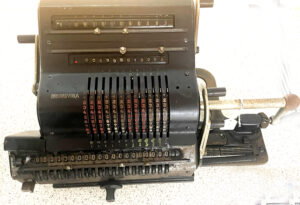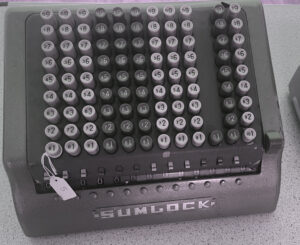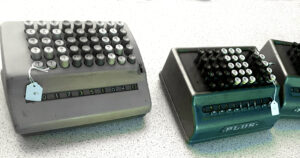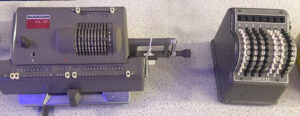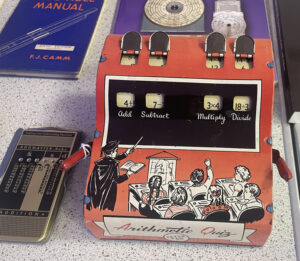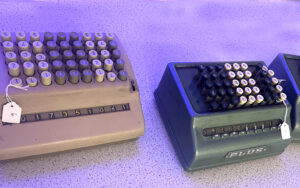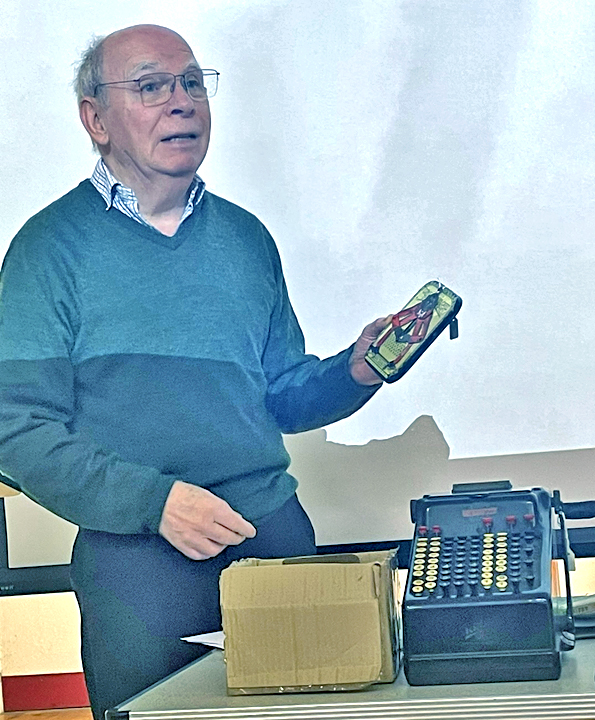
Brian began by stating he used mechanical calculators at school and the slide rule at university so he decided to do a talk about Adding Machines and Mechanical Calculators in his collection.
Before we got to numbers we first learned to count. The Mayans, Aztecs and Celts used their hands and feet to arrive at a total with a base 20, The Sumerians and Babylonians chose a base of 60, although we don’t know why, which is where our present divisions of the hour into 60 seconds and 60 minutes, along with 360 degrees in a circle come from. Counting using hands and feet was widely used, but the earliest counting tool was a bone marked with notches, this was around 30,000 BC. Counting pebbles have been found dated to around 4000BC in Iran. With the invention of an alphabet, writing by the Phoenicians around 2000 BC, letters were devised to denote numbers, then actual numbers came along. Moving forward in time, there was the Abacus or counting frame.The earliest form came from Mesopotamia around 2000 BC .Developed over time it was used in Egypt, Persia, Greece, Rome and China.
Arabic numerals were introduced in England gradually from the 15th century, becoming widely used in the 17th century replacing Roman Numerals. The Scottish mathematician John Napier published an article in 1614 introducing logarithm tables, used to make complex calculations possible. The slide rule, invented by William Oughtred came along in 1620. With Log Tables they were used for the next 300 years.
Many Calculators and Tabulators were on display along with various slide rules.from Brian’s collection.