All posts by G4YRF

13 March 2025 – I Wasn’t expecting to hear that! By Brian, G8GHR


Brian started by thanking Paul for last week’s first class talk. He thought it would be good to follow up with a dip into his LP collection which he had recorded onto mini discs for convenience. He said “at the end of this I hope you will be saying I didn’t expect to hear that!” He said he could generalise the recordings on 78 rpm shellac as either classical or light entertainment such as Love’s Old Sweet Song from 1933 by Musical Dawson’s Famous Choir of Canaries.

Brian said I don’t think you can under estimate the importance of the LP as they became available in the early 1950s, if only because there was very little other means of entertainment. The BBC only had one TV channel and three stations on the radio.

Recordings in the 1970s began producing LPs of early radio broadcasts. One from Radiola contained a number of speeches by Hitler and also the last broadcast by Lord Haw Haw. Included and played by Brian was Charlie and his Orchestra from Berlin in February 1942, a version of ‘Daisy Daisy’ with many word changes to fit Nazi propaganda.


Brian also had a recording by Tokyo Rose from August 1944. He said “by the way, Tokyo Rose was not just one person, but many, broadcasting Japanese propaganda during the war.” There were many other discs produced during the war by the Americans featuring famous people like Bing Crosby, Glen Miller etc. for the American forces. All during the talk Brian played excerpts from many of these recordings.

Moving on to 1972 a BBC recording of Yuri Gagarin in space in 1961 was played followed by the first American in orbit, John Glen in 1962

Following on in the demo were recordings of the sounds and murmurs of the heart. Most likely for students but probably not popular with the public. Also a recording of limited interest, ‘How to pass your driving test’. That was followed by Bob Newhart with his deadpan delivery style giving his version of “The Driving instructor” had every one in stitches. Another unexpected recording on LP was Morse Code. I expect that would be a very difficult way to learn.

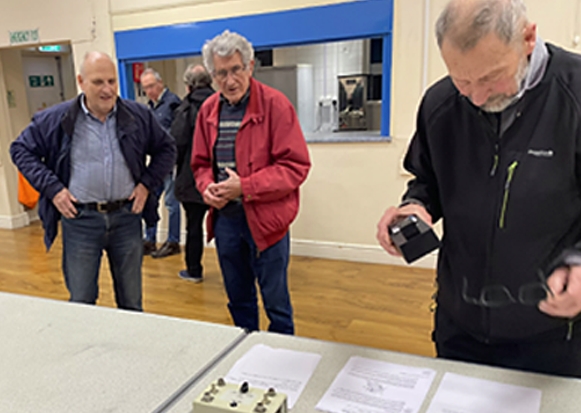
At this point, Brian said ‘ I thought you might like to see some of my collection of Morse keys displayed nearby on the table.

Brian showed an American LP from 1976 called ‘Everything you need to know to operate CB Radio’, Mostly jargon! Other unusual subjects recorded on LP included the story of the Lone Ranger and how he got his name. The broadcasting began in 1949 and ended 1957 in America.

At the end of 1950 the BBC started broadcasting various pop programmes including Juke Box Jury with David Jacobs and the Six Five Special which began in February 1957. These were included in a series of BBC LPs called “40 Years of Television “ issued in 1976. Brian played the “Six Five Special”. Of course the BBC are known for their comedy programmes in the 60s and 70s, many were put onto LPs. For instance: Dad’s Army from 1973. every one remembers “don’t tell him pike!”Then Brian closed with The Two Ronnies.

So it’s Goodnight from them and Goodnight from me, Thank you.

6 Mar. 2025 – Records – speeds, sizes and developments by Paul Schimmel

Paul’s brilliant demonstration began in 1877 when Edison announced his invention of the Phonograph. Originally recording on cylinders wrapped in tinfoil, The design was based on a machine to record Morse Code! During the period 1877 – 1887, while Edison was preoccupied with electric light, others improved on his Phonograph. Alexander Graham Bell and associates substituted wax cylinders for those wrapped in tinfoil. That improved fidelity and could be shaved and re-used. At that time, the Columbia company began.

In 1888 Edison produced the Perfected Phonograph using wax cylinders. But, wax wore out quickly and was fragile and difficult to duplicate. In 1887 – 1888 Emile Berliner patented the Gramophone. Initially not very successful due to poor sound and hand winding that produced inconsistent speeds.

Moving on to 1888 – 1900, various materials were used for discs, eventually settling on shellac. By 1900, Berliner transfers patents to Johnson who renamed the company ‘The Victor Talking Machine Company.’ All they needed was a memorable trademark. In 1899 via their English subsidiary came Nipper, the famous dog looking into the horn of the machine.

During 1900 – 1914, Cylinders lose ground to the cheaper and louder Discs which also have better repertoire. In 1912 Edison launched a new but incompatible disc system. However the system had good sound quality but noisy surfaces and the user had to buy Diamond stylus! But at least you could have famous artists in your home but only for a playing tune of five minutes.

During the early 1920s there was stagnation, no major technical advances for years, although small disks were released to reduce the cost, but the discs were still limited to five minutes playing time.

Paul with a small disc

Paul then displayed several discs and played them on a modern player. There was one from Pathé (1912), Edison (pre 1921), and Mimosa (1925) which did sound the best.

In 1923 the World Record Controller increased playing time by attempting constant linear velocity, although with rather poor results. In 1924 Western Electric developed electrical recording system with much better sound quality. During 1926 Edison experimented with long playing discs at three times playing time but it was not a success.

At the time of the Wall Street Crash in 1929 Phonographs and Gramophones were a luxury in America. Edison exits the phonograph business and RCA bought Victor. In England Columbia and HMV merged to form EMI and Edison Bell and various smaller firms went out of business. During 1930s there were attempts to reduce costs by making various sizes of discs, and some of the plastic discs try to increase playing time . Most of the 1930s plastic discs have not aged well and are difficult to play but those made with shellac have no problems.

Paul then played three more discs: one from Edison Bell (1929), one from Durium (1932) and Columbia (1928) The demo showed the progress in sound quality through the years, Columbia sounding the best. Also during the 1930, RCA attempted to market long playing records in the US (running at 33 1/3 RPM while A. D. Blumlein at EMI researched stereo recording in the UK. Both developments were too far ahead of their time.

During 1948 Columbia introduced the LP record with microgrooves at 0.001 inch, and steel needles gave way to sapphire and diamond. Shellac gave way to Vinyl and stylus pressure was measured in Grams not Ounces! The next year in 1949 RCA released the 7 inch 45 RPM record.

1950 In the UK, Decca introduced the LP record using their Full Frequency Range Recording developed during WW2. 1950S also saw the introduction of multi speed turntables. Later during the 1050s, LP discs opened up the market to HI-Fi Enthusiasts. Major labels agreed a standard for stereo using the Blumlein system and it was found that mono cartridges were not compatible with stereo records.

A new market opened up to Teenagers in 1960, Pop groups produced 45 RPM discs playable on light weight portable players.

1970s saw Quadraphonic systems (three systems!) but the public did not take to it and in 1982, Sony and Philips introduce Compact Discs producing perfect sound forever and 74 minutes playing time.. New LPs slowly disappear.

A lively Q&A followed till closing time.


MyThanks to Paul Schimmel for providing all this info and Thanks also to Brian Farey, G8GHR for the display of a few of his record players


27 Feb 2025 – A Video evening

Don, G4LOO presented members with a long list of videos first presented at the RSGB Convention last year and asked members to choose one.  The result was a bit of a surprise as they chose Radio astronomy. Mapping the Milky Way’s arms and demonstrating Dark Matter from your garden by Dr Andrew Thornett, M6THO

Dr Thornett began by describing how to make a Corner aerial from chicken wire!  It is on a metal pipe frame just over six feet high and about eight feet wide.  He then went on to describe his giant parabolic antenna made from an upturned garden parasol with a light metal screen lining. He also described his Parmigan Triffid Military Phased Array given by a friend and mounted on a wooden mount. Under the mount was a box containing a mini PC, SDR & Sawbird H1 LNA. For 21cm the aerial was an Alex Pettit Patch Yagi antenna, Small, light and home-made which worked brilliantly.  His most recent acquisition was a 150cm solar cooker dish!  (small dish antennas)

There followed lots of beam widths for various aerials. He explained that his set up was sufficient to show the various arms of the Milky Way etc. which displayed as depths of red and white traces on various charts.

The second video chosen was ‘QRP: fun or folly?’ By Dr. Bruce Macaulay, G4ABX who began by saying his grandparents gave him a wonderful AR88 receiver for his seventh birthday, they then bought him a Philips Electronics Engineer kit for his eighth birthday and within a week he had constructed every project in the kit.   He said by then he was hooked!

His first QRP rig was a Heathkit Twoer, super regen RX wide as a barn door, AM TX/RX with a few watts and crystal controlled TX. He had built it from a kit which began his love affair with Heathkit.  Later his first HF QRP rig was the Heathkit HW8. That was a wonderful introduction to HF QRP. It ran 2 to 3 Watts and was CW only on 80, 40, 20 and 15m. He built it from a kit and still has it today

He pointed out that when going to HF there were a few things he wanted and one was small size and weight. That led to a very small rig known as the Mountain Topper. a Tiny credit card size  3 band CW transceiver, VFO controlled, 2-3 Watts with Crystal ladder filter and built in keyer all running from a 9v PP3 battery. Through time the rigs got smaller but not more powerful. These small rigs are useful with a small aerial for use in Parks on the Air, or even up peaks.

Numerous other QRP rigs were described, such as the K2
and others from Elecraft.  Used with an end fed half wave antenna Dr Macaulay worked many very distant stations around the world.   
 

20 Feb. 2025 – A talk by the Construction contest winners


David G4FKI started the presentation by showing his CW Beacon from a design by G4JNT. As a relative new member of the club he has never had an opportunity to enter before, hence his entry in the oddly named ‘novice’ class.

David’s CW Beacon

Don, G4LOO decided to explain all of his entries starting with the smallest, the Clamp on current meter for testing for current on coax or RF on wiring etc.

Don’s coax Current meter

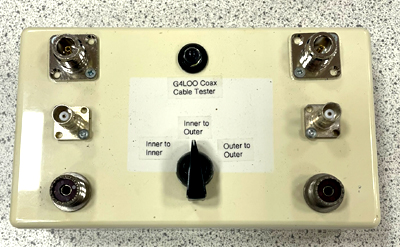
Next was his Coaxial Cable Tester. Although rather simple in design it is very useful in testing any terminated cable with any type connector to check continuity.

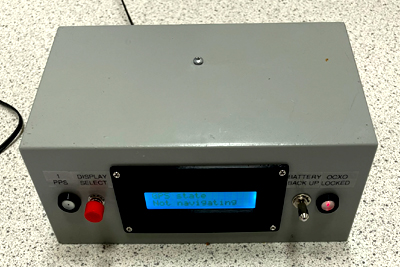
Much more complicated was Don’s Kit entry, a GPS Disciplined 10MHz Frequency Standard built up from various modules. Don explained the circuit diagram but to this writer it was much too complicated to follow.

Don's GPS Frequency Standard

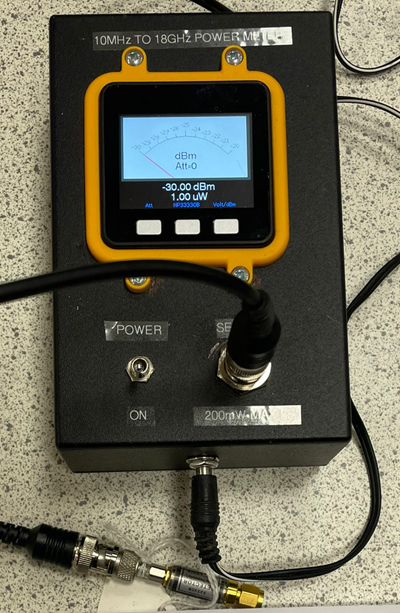
Don's Power MeterAnother kit project was the 10MHz to 18Ghz Power meter.
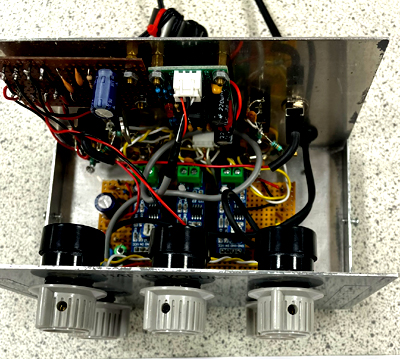
One of Don’s Major Project entries was the Headset Mixer, which sounds simple but in reality contained a myriad of parts to allow amplification of headsets and microphones to allow two operators to hear and speak to each other while listening to the receiver and allowing to main operator to transmit audio.


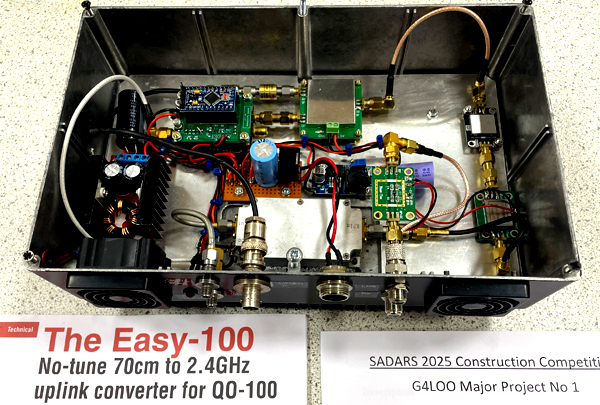
Last but not least was the Easy – 100 No Tune 70cm to 2.4GHz up link converter for QO-100 Satellite. Easy is an understatement when you see all the modules connected up. This was indeed Don’s Major Project!Don's Satellite Frequency Mixer

06 Feb 2025 – Annual Construction Contest

The Club’s annual construction contest was held on Thursday, 6th February

Left to right, Don, Ian and Paul


This year’s winner is Don, G4LOO with his satellite frequency mixer, entered as a Major Project, shown below.

Don's Satellite Frequency Mixer


His GPS frequency standard won as the best Kit construction.

Don's GPS Frequency Standard

Followed by his winning entry in the Weekend project competition, the clamp on coax current meter.

Very Well Done Don!

—————————————-

The winner in the Novice class (meaning a member who has never entered this contest before) was David G4FKI who submitted
a CW beacon.

Other entries from Don:-

Don's Power Meter

Don's Headphone mixer

23 January 2025 – The Inside Line of F1, by Steve Porter

Steve introduced himself as the son of one of our members, Richard G3NII.

Steve Porter
Steve Porter

He said he was born in 1983 and because his parents were heavily involved in engineering his interests in all things mechanical was from an early age.

He added that dad always had sports cars and that started his fascination with cars.

He moved on to Top Fuel drag racing, the fastest and most dangerous race cars, essentially a bomb on four wheels. The fastest competitors can reach over 340mph and cover the 1000 foot track in 3.6 seconds!

He was not a driver, but worked as part of the trackside support team. The teams travelled around to world to various races.

2008 saw a change to his trackside life.

Steve Porter during his presentation

He moved to FIA F2 racing. After two seasons in Formula 2 he started his job as a data engineer with Team West-Tec, racing formula 3 cars around Europe at some historic and well known race tracks. He then spent time trackside with F3 and GT racing, that was 2010-11.

His formula 1 journey began in 2011 by joining Pirelli who transport over 60 personnel around the world to attend every race and test, including engineers, scientists, technicians, logistics, IT, media and R&D experts- even chefs and hospitality staff!

Steve said that over a weekend of racing, Pirelli technicians fit over 1,680 tyres. They actually start fitting tyres on the Tuesday before the race. With 23 races in a season, that means 38,640 tyres in a year! (that excludes testing and other events)

At the end of the race on Sunday night, all of the tyres are stripped from the wheels and are taken back to the UK to be recycled.

Steve’s trackside events are too numerous to list here, but his talk was very interesting and led to a good number of technical questions and answers.

16 January 2025 – The history of Bletchley Park by Peter Marcham, G3YXZ

Peter spoke for over an hour without notes. His topics were well rehearsed and held the attention of the audience throughout.

Peter Marcham G3XYZ
Peter Marcham, G3YXZ

He detailed the need for wireless security from the very earliest days of radio communications.

The organizations grew through the years to Bletchley Park and on to GCHQ.

Anyone with the slightest interest in radio security would do well to visit Bletchley Park for a tour, especially one conducted by Peter.