All posts by G4YRF

18 May 2023 – Dynatron history by David Wherrell

The Dynatron brand was founded in 1929 by H. Hacker and Sons Ltd.  Operating from premises in Maidenhead they produced small quantities of radios and established a reputation for quality.

David continued by describing early models of radiogramophones and radio receivers. Through the years the company merged with others but were still known for their high quality units. Their cabinets were designed to match quality furniture; some even had drawer fronts to conceal the electronics. An example was the ‘Ether Empress’ cabinet.

Their first television models produced in 1939 were built in a cabinet which also housed a record player and radio, but it was not widely accepted by the public. Perhaps it was too large and expensive.

The company changed radically when in 1945 they started producing RADAR equipment for the ministry. They had no less then forty major contracts designing, developing and building training equipment for the RAF personnel and RADAR operators.

After the war, Dynatron resumed design and construction of high quality radiograms in furniture grade cabinets.  In 1957 the company merged with Ekco and moved to a new and bigger factory, still in Maidenhead.  After just five years in 1962 the company was absorbed into the Pye group, but the Dynatron name continued and they produced the ‘Magnificent Queen Anne’ Music Centre. David showed a photo of one still in use today!

The ‘Mazurka’record player was one of the most popular models from the Ekco era, and it continued in production for some years after the move to Pye ownership.  TV production in Lowestoft included new dual-standard models equipped for the new 625-line system, launched with BBC2.

The Model TV75 was one of the first, using a Pye chassis fitted in a Dynatron-designed period-style cabinet with a large loudspeaker producing superior sound quality.

Other TV models had contemporary cabinets in walnut and the fashionable teak veneers. New ‘Music Centres’ were developed at the King’s Lynn facility for Pye and Philips brands. They sold well.

In 1979 the recession was beginning to bite and sales of electrical good were in decline.  Philips reluctantly made the difficult decision to close the King’s Lynn factory, effectively sealing Dynatron’s fate. Production ceased in early 1980. However the Dynatron brand re-emerged under the name Roberts Radio and a range of music centres made by Loewe-Opta, a German Philips brand. They sold well and some are still for sale online today!

A Q&A session followed David’s presentation. There was considerable interest in some technical aspects and the products on show.

David presenting


11 May 2023 – Video Evening

G0UPL, Hans Summer introduced the QCX CW transceiver kit story, design, development, and evolution in this forty-four minute video from the 2022 Convention.

Hans has a masterly grip on the technical side of design and development which led to this very successful product achieve sales of 18,472 units by October 2022, and still growing.  He said “the demand was beyond by wildest expectations”

The video is on YouTube, just search RSGB 2022 Convention, The QCX CW transceiver kit story

The QCX CW finished kit

A history of Orfordness by Nick Cooke

The presentation gives an overview of Orford Ness, which is positioned off the Suffolk coast, twenty miles East of Ipswich. This shingle spit was the location of intense research, which started during WWI and continued during WWII. After the end of WWII, the research continued during the Cold War period, under the control of the Atomic Weapons Research Establishment {AWRE}!

The presenter Nick was a research scientist at the Royal Aircraft Establishment {RAE} at Thurleigh, Bedfordshire, which had many similarities to Orford Ness. He explained the history of Orford Ness from its early beginnings in 1913, primarily investigating the use of the aircraft as a weapon. Development of numerous aircraft types took place, along with the improvement of dropping bombs, weapon aiming, the development of oxygen equipment, aerial reconnaissance and the development of a new piece of equipment, called the parachute.

Research continued during the inter-war years and during WWII this continued improving aircraft such as the Supermarine Spitfire and the Hawker Hurricane, along with optimizing their fire-power. Many of the buildings that were used in this pioneering research {Bomb Ballistics building etc.} are still present today, with descriptive exhibitions inside.

Radar, which can be argued as the technology that help to win WWII, was developed at Orford Ness by Robert Watson Watt and his team of boffins, before it moved to Bawdsey Manor, located on the mouth of the River Deben, in Suffolk.

The presentation then gave an overview of the work by the AWRE, this work started in 1953. The various AWRE buildings were described, especially the peculiar test laboratories called Pagodas. These can also be visited during an official National Trust tour. Various images were shown of the inside of some of these historic test cells.

The presentation ends by talking about a very secret project called Cobra Mist. This Anglo-American project was researching into Early Warning, Over the Horizon, Radar systems. This very expensive project {£120 million in its day} commenced during 1968 and terminated in 1973. The old Cobra Mist control building is currently being used by Radio Caroline!

Peace and tranquility eventually came to the Orford Ness site in 1993, when the National Trust took control of the site.

The 70 plus years of secrecy and mystery had come to an end.

Text by Nick Cooke

13 April 2023

The Club held their Annual Spring Junk Sale, with a good turnout of members and guests, keen to pick up a bargain.

Don (G4LOO) and David (G8UOD) were the auctioneers, and were kept busy by a good turnout of keen bidders.

The raffle was a great success too, very nearly breaking the record for takings, set over 10 years ago.

Thanks to everyone who helped make the evening a great success!

23 March 2023 – The AGM

Twenty four members attended the AGM, that was a very good turn out!

All officers and committee members were returned unopposed with the provision that the Chairman will step down on 22 June. On that day (a Thursday) we will have an EGM to elect a replacement.

Discussions took place during the call for any other business. Mostly about future plans for the club.

The elected Committee and Officers are:

Ken Amos, G4YRF, Chairman                                                                                    David Lloyd, G8UOD, Secretary                                                                                 Owen Williams, G0PHY, Treasurer                                                                   Don Ross, G4LOO, Equipment and Contest Officer                                        Paul Bradfield, G1GSN                                                                                             John West, G6RHL                                                                                                          Terry Rose, G4OXD                                                                                                       Graham Lamming, G4JBD


16 Mar 2023 – An intro to VOACAP by Ken, G4YRF

The intro began with a short history of Voice of America transmissions and sites, including changes made after the cold war ended with stations being closed due to the advent of newer methods of communications, i.e. the internet and mobile phones etc.

Turning to the VOACAP propagation programme, it was shown that the software had been modified from the earlier ‘area coverage’ to ‘point to point’ forecasts more suitable to Radio Amateur needs.  The software was, in fact, rewritten by radio amateurs for radio amateurs.

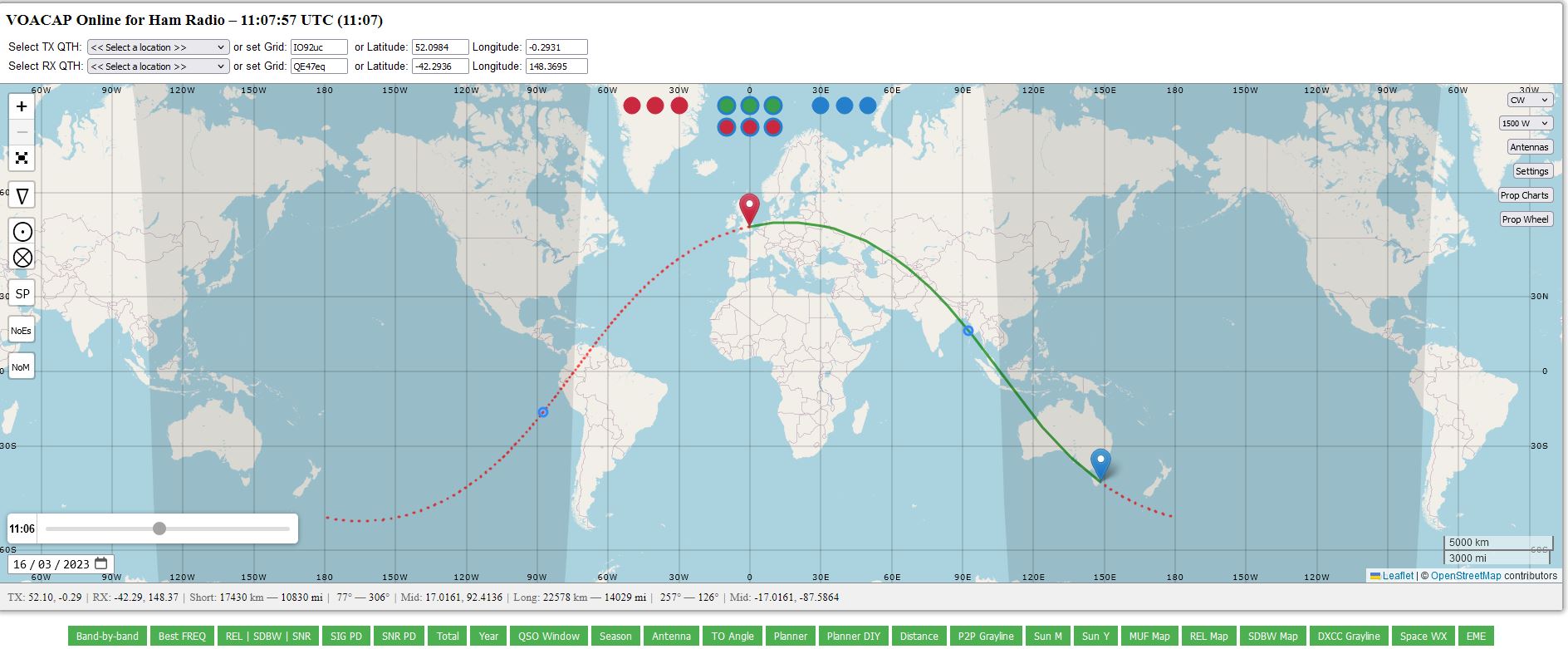
Looking at the map, it was pointed out that most settings required by the user were grouped in clusters at the top corners of the display. In the power tab, there is a choice from 0.1W up to the excessive 20000W. (quite ‘over the top’ for amateur radio ops.)  Mode selection includes CW, SSB, AM, FT8, FT4, and WSPR.  Included is a long list of possible antennas for TX and RX. Fortunately, in the Settings section the three day Sun Spot Count is filled in automatically, but a choice can still be made for forecasts for transmissions to be made months in the future.  The included Help File is comprehensive and easy to use.

Opening view of VOACAP.

Find the site at www.voacap.com/hf/


23 Feb. 2023 – SMD Soldering Practice

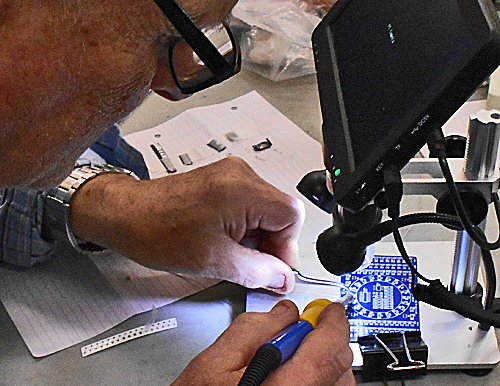
The evening began by Don, G4LOO showing SMD parts through a microscope which sent the  picture to a video projector and onto the screen.  The magnification must have been by hundreds of times.

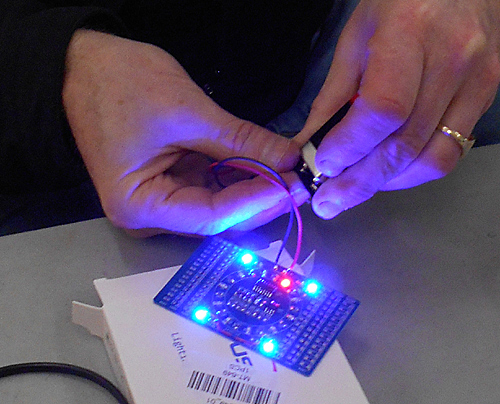
As an introduction to SMD, members had seen the RSGB video showing the process of soldering such small parts. Seven members were brave enough to tackle the soldering during the evening. The hardest chore was identifying the actual SMD parts!  Some members had chosen to work on the SMD practice kit at home.

This practice session will continue next Thurs evening.

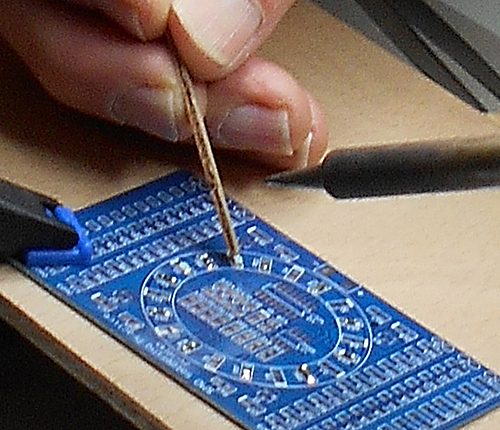
Members making a start
Don (left) checking the video
Close up Soldering

16 Feb 2023– Construction Winner’s Talk

Don, G4LOO began the evening with a quick run down of the RTTY contest of the week end. The score looks good and we await the final results.

The main programme started with Don’s explanation of his Weekend Project. The original details were published in PW June 2016. The item was an entry in the 2015 Hackaday one square inch competition.  Much later, Don acquired a commercially made board and started collecting the parts. The main delay in the building was the unavailability of a 74VHC4052 IC.  Upon completion the unit was plugged into an NTL dongle to up convert  HF frequencies to VHF

The One Inch PCB

The Kit Construction project explained next was Don’s Iceni 432MHz Transverter designed by Sam Jewell G4DDK.  Don added a 30W Power Amplifier and control circuitry to the complete the project.

The Kit Construction Project

The Major Project was a 70MHz 300w Linear Amplifier which Don started with a part assembled kit from Enigma Components Ltd. Combined with a 48v and 12v power supply with coax changeover relays and LCD display controlled by an Arduino control unit, the finished project can handle an SWR of more than 65:1. It has been tested into open and short circuit loads at the output without damage. With efficiency of about 70% at 350W with 48v the power gain is more than 22dB equal to 2W input for 300W out. The harmonic output is less than 70dBc at 140-150MHz.

The 70MHz 300w Linear Amplifier

It’s no wonder Don had been chosen as winner in all three categories in this year’s construction Contest!


2 Feb 2023 – Soldering SMD videos – Don, G4LOO

Credit:By Aisart – Own work, CC BY-SA 3.0, https://commons.wikimedia.org/w/index.php?curid=4071999

The first video showed how professional production companies use state of the art equipment to solder surface mount devices to thousands of boards in minutes.

Next was an RSGB video introduction to surface mount device soldering for the radio amateur. It was apparent that good light and magnification were essential. The video showed step by step methods for different size devices and what to look for in good and bad solder joints.

It was pointed out that on another evening in the club’s programme, members would be given a chance to do their own SMD soldering practice using a small kit of parts provided by the club.

For those who would like to review the details of the methods used in SMD, view below: