Category Archives: Uncategorized

17 May 2018 – Power supplies, how good is yours?

Bryan, M0BIK opened the evening with a slide show explaining the ins and outs of conventional power supplies.  The choice of components was discussed as to which were better for various applications. It was noted that the later use of toroidal transformers meant a unit of less weight could be made which was more efficient.  Various circuit diagrams were discussed with reference to good and not so good practice in design.

Don, G4LOO then took the floor and said he was going to tell about cheap power supplies. His units are based on surplus or second hand server power supplies. They can be found at very low cost from time to time on popular auction sites. Most  will provide 12V or  possibly up to 12.3V if modified slightly and produce an attention getting 47Amps!  Other very small power supplies and converters from the same sites were passed around for members to check.

Paul, G1GSN, then finished by displaying his ‘portable’ LPG gas/petrol generator which was about the size of a suitcase and produced mains voltage. Paul explained the benefits of using LPG outweigh that of petrol in that you are not limited to the size of the petrol tank, just use a larger bottle of LPG.. The gas is more efficient, as well, running for a longer time without topping up. This power unit was much larger than any other shown on the evening, though.
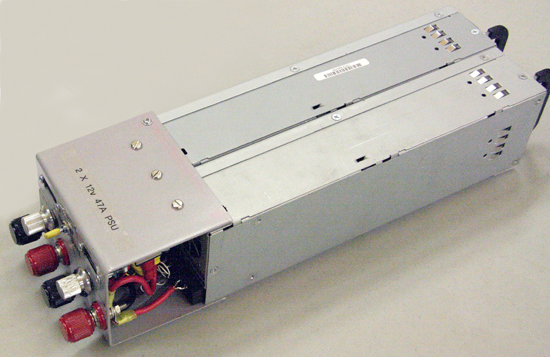
Don’s 2X 12V 47A Power Supply


10 May 2018 – Video Evening

The first offering was a quick explanation of the workings, frequencies and differences between RFID, NFC and BLE systems.

The second video was the 1993 account of AH1A DXpedition to the Pacific Island of Howland which almost ended badly. The Island hadn’t seen rain for almost a year but when the 10 radio operators and 2 US Fish & Wildlife Service Representatives finally settled in, the rain started pouring down and continued for several days till everything excluding the equipment was wet. The water soaked into the earth and the Guano began to smell. One op said the island was like the bottom of a bird cage. High seas meant problems with their sailing yacht anchored off shore in that they lost power and were unable to charge the batteries to get the boat engine started, if needed.  The surf continued to run high and nobody was able to leave the island safely.

Fortunately, the wind abated and the surf swell dropped. All departed the island with equipment and tents, albeit six days later than planned, their goals having been achieved.

The Latest Club Project — 4 May 2018

The CW Keyer Kit

Richard, G3NII has produced another of his excellent kits for our club members. As you can see, it is very complete and we’re pleased to think the uptake has been very good, even non CW users have opted to build one.

Unfortunately, the list for kits was for members only and is now closed.

3 May 2018 – Low-level Electromagnetic Field exposure and health by Graham G3WQT

The Cushcraft A3S

Graham started by introducing the members to The Institution of Engineering and Technology. The IET is one of the world’s largest engineering institutions with over 168,000 members in 150 countries. It is also the most multidisciplinary – to reflect the increasingly diverse nature of engineering in the 21st century.  The current Royal Charter and Bye-laws of the IET came into effect from 1 October 2016.

Graham was one of 7 members of the Biological Effects Policy Advisory Group within the IET whose task was to determine if there are harmful biological effects of low-level electromagnetic fields at frequencies up to 300 GHz.  It was explained that possible dangerous EMFs depend on frequency, magnetic and electric fields, exposure time and distance from the source.  While high levels can be problematic, it was shown that for the most part, power levels used in British Amateur Radio are not harmful if precautions are taken.

Based on the FCC bulletin OET65, a safe distance (in Feet) from a Horizontal half-wave dipole wire antenna with a transmitted power of 100W at 3.5MHz is 2 ft., at 7MHz,  3.5 ft, at 14MHz, 7 ft, at 21MHz, 11ft and at 28MHz, 14 ft. In use these wire antennas are usually as high as possible and nearly always at 25ft or more. At 400W the safe distance from a wire dipole is equal, in feet, to the frequency is MHz. I.E. at 28MHz: 30ft.  Safe distances from a triband Yagi can be more. These figures do not apply to magnetic loops etc. which can have significantly higher fields depending on frequency and power used. It is recommended the loops are not used in the shack or indoors for transmissions.

A link to an Amateur Radio RF Safety Calculator was given as: http://hintlink.com/power_density.htm


26 APRil 2018 – Baldock RADIO station HISTORY by james loughlin

James Loughlin (picture from LinkedIn)

James Loughlin was the OFCOM UK Accreditation Service (UKAS) Technical Manager before he retired in April 2017.

A very good turnout of members and visitors enjoyed James history of Baldock Radio Monitoring Station.

Initially (around 1930) the station received Transatlantic radio telephony signals from New Jersey USA, and continued to use HF bands to monitor international Radio Circuits operated by the GPO.

The station is now called the OFCOM Baldock Radio Monitoring Station and the frequency range covered is 9 kHz to 3 GHz.

On receiving complaints of interference, the station can deploy remote monitoring systems placed around the UK together with measuring vehicles if necessary, to track interference sources.

One time the interference being assessed was found to be caused by Jammy Dodgers biscuits being cooked in an oven!!

James described how the station has been testing the use of drones for example to help diagnose problems with radio masts.

Passers-by have recently asked them to broadcast a request as they thought it was 3 Counties Radio.

The station has an amateur radio call sign of G8GPO and is active on 475kHz and other bands.

(Report by Alan, G4PSO)


For more information see: https://www.ofcom.org.uk/__data/assets/pdf_file/0032/35879/baldock.pdf

19 April 2018 – Oscilloscopes, by Bryan, M0BIK

Bryan began by saying he last did a similar presentation in 2002. This time he had eleven oscilloscopes lined up on tables in front of the members; all units were seen to be working.

The first slide of the presentation asked, What does it do? (it displays voltage waveforms against time), What is it useful for? (useful for observing voltage waveforms) and Do I need one?

The majority of scopes on display were ‘vintage’ and most obtained for little money in spite of their original cost which, in some cases, was considerable.  Some were made to function properly with only a dose of switch cleaner!

Bryan went on to explain the types of scopes and what the various controls could achieve. A brief look at wave forms and measurements followed. Bryan explained that the trace can tell many things about a signal, such as, the time and voltage values, the amplitude (voltage) and frequency of a signal, determine if a malfunctioning component is distorting a signal, determine how much of a signal is DC or AC, and observe any noise on the signal.

He then came to the question, Do I need one? Although the question wasn’t answered directly, it was pointed out that the units can be found at rallies and junk sales for £25 and less, and in working condition!

Members were invited to have a look and adjust the various controls of the units on display.

Bryan (Left) making adjustments.


12 April 2018 – Clive Sinclair, by Brian, G8GHR

Brian demonstrates ZX Spectrum+2

Brian’s presentation had all the usual flourish in that many working items were on display which had been developed by the subject of this evening’s presentation.

Brian explained that Sir Clive Sinclair is best known as an English entrepreneur and inventor, most commonly known for his work in consumer electronics during the late 1970s and early 1980s.

Clive started out as a writer and editor of electronic publications, but soon had ideas about producing electronic products which were smaller and less expensive than anything on the market at that time.  Although many items were before their time, they were dogged by the quality of the components and quality control during manufacture.

Brian charted Sir Clive’s progress through the years by displaying and explaining the miniature radios, small digital calculators, electronic test equipment, very small portable TV sets and eventually computers.

The C5 electric miniature car and electric bike were among Clive’s last efforts. He’s aparently now retired and appears to have finished innovating.

ZX80, ZX81 and DM2

22 March 2018 – The AGM

Almost all registered members attended the AGM last evening. All reports were read and approved by the meeting. The Officers and Committee members   were returned, unopposed. They are:

Ken, G4YRF             Chairman
Bryan, M0BIK           Vice Chairman
David, G8UOD         Secretary
Owen, G0PHY          Treasurer
Don, G4LOO             Equipment Officer
Don, G4LOO             HF Contest Officer
Paul, G1GSN            VHF/UHF Contest Officer
Martin, M0XMP         Committee member
John, G6RHL           Committee member
Gareth, M5KVK        Committee member

Victor, G3JNB presided over the re-election of officers and committee members.

Cups and Plaques were presented to winners of the Construction Contest. They were:

Kit section: Don, G4LOO for his Scalar Network Analyser, the Dr Little cup and plaque
Weekend Special: Victor, G3JNB for a junk box wave meter with digital display: G2DPQ cup and plaque
Major Project: Paul Tewkesbury for the CS Series transceiver, a Commendation  Certificate.

The G3JKK Shield presentation for Club Support this year went to David, G8UOD.
Lastly, the Club Quiz Trophy was won by Team KT66 ( Bryan, M0BIK, Don, G4LOO, Geoff, G4CEP and Paul Schimmel.) The trophy was received on behalf of the team by G4CEP.

The club members present voted for the best talk by a member and the winner this  year by just one vote was: David, G8UOD’s presentation ‘The Most Secret Telephone Exchange’