20 Oct. 2022 – A refresher on contest equipment setup

Don at the K3 controls

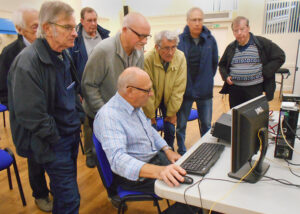
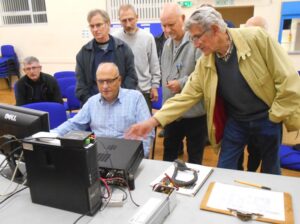
The subject was ‘what’s new and how to use it’ with regard to the equipment planned for use in this year’s CQWW SSB contest.  Don, G4LOO set up the K3 with a panadapter and logging program. Various controls on the K3 were pointed out and discussed. Some discussions followed about the panadapter and how it can be useful during the contest. A short run through of the logging program was followed by an extensive Q&A session.


13 Oct 2022 – Elephant Cage a talk by Graham G4JBD

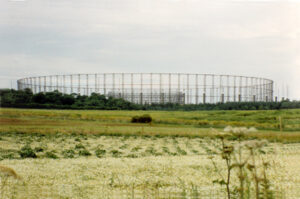
FLR-9 Elephant Cage

Almost everyone who had seen the structure knew it was called the ‘Elephant Cage’ due to it’s giant circular structure. This receiving aerial was a step forward in direction finding and monitoring radio signals. Graham pointed out that there were a further eight similar aerials situated around the world enabling signals to be pinpointed almost any where on earth. The worldwide network was known collectively as ‘Iron Horse’

The construction at Chicksands began around 1960 and was completed by1962.  The outer reflecting screen had 1056 vertical steel wires supported by 96 120-foot (37 m) towers. There were three concentric rings of antenna elements. Each received radio signals from 1.5 to 30 MHz. depending on how they are tuned.

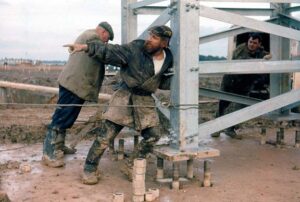
installing one of the 120 ft towers
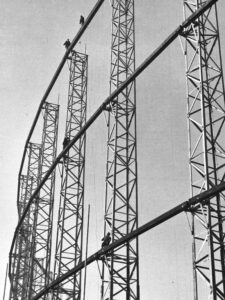
The towers with wooden rings around

Graham covered early direction finding equipment and the nature of the signals monitored.

The structure at Chicksands was dismantled in 1996 as it was obsolete. Only a large indentation in the landscape remains.

As a PS:

Claimed by W7UUU as the oldest FLR-9 in the world!


6 Oct. 2022 CQWW SSB Planning by Don, G4LOO

Don began with a look at the results of a previous contest, the IOTA contest at the end of July. He compared the results received with past years, although past years were affected by the Pandemic.

Moving on to this October’s CQWW SSB contest, he said some of the assembley work will be done and tested prior to the setting up of the stations. With regard to the operations, he pointed out which stations to log for points and which to avoid.

The Rota for this contest has been posted on this website and listed is also the email to use to have your name entered into the slots for operations during the contest.

29 Sept 2022 – video night by Don, G4LOO

The video chosen by Don for this evening’s program was from YouTube (RSGB Tonight @ 8) First presented as a live stream on Monday 9 May 2022. Called Contesting: pushing the boundaries by Mark Haynes, M0DXR.

Mark explained the ‘When, why and how’ of modern contesting, mostly with regard to HF contests. To be complete, the explanations started at very basic contesting but then followed up with very advanced techniques. Some views of very advanced (expensive!) stations were shown.

See the video at:  https://www.youtube.com/watch?v=dDZ056alQ6c

Or go to  Youtube.co.uk, and search for ‘RSGB Tonight@8’

22 Sept 2022 – Measurements with Nano VNA by Bryan, G8DKK

One of Many VNAs available


Bryan started by showing a list of topics to be covered which included NanoVNA features, architecture, calibration (including calibration kits), Measurements and PC software. It became immediately apparent that there are more than one version of Nano VNA.

While smaller less expensive units are available, they might prove difficult to read and have shorter battery life, as well as possibly being less accurate at UHF frequencies. A description followed of the NanoVNA-F 4.3″ package which includes instructions, a calabration kit, connecting cable and connectors. It was pointed  out that most units come with a calibration kit, useful since the VNA will need calibrating with any change of conditions, such as a different cable, temperature changes, and different connectors etc.

Bryan explained the architecture of the VNA-F and the components used.

The next VNAs described were the LiteVNA 62 & 64 which have 2.8″ and 4″ screens respectively and have measurement points of 51 to 1024 points. A new feature added to this model is the ability to store one set of calibration data.

Various measurements were explained and  PC software was listed, two of which are given in the instructions. They are Nanovna.exe, and  Nanovna-saver by Rune B. Broberg. A third programme is also available, a modified version of nanovna called nanovna#.

NanoVNA and NanoVNA# are capture and display programs. They can run calibration routines but with 101 points only, plus save & load files in Touchstone format. The NanoVNA Saver is a large program with many features including chaining sweeps to gainmore than 101 display points.

Bryan finished his talk with a Q & A session.


14 September 2022 – our first meeting after the break

Our return to the club was to have taken place on 8th September, but the sad passing of our beloved Queen Elizabeth II earlier in the day demanded dacorum and respect, so the meeting was rightly postponed.

The following week, a small group met at the club house on the 14th and, over tea and biscuits at the bar – courtesy of the club – discussed the sad events of the past week.

We then convened for an informal discussion on our radio activities, among others, over the holiday period, chaired by Paul, G1GSN.

We discussed the article in this month’s RadCom, regarding the trend to a move from conversational contacts on the air to dry, automated exchanges of reports.

Graham G4JBD mentioned that he had been experimenting with a recently introduced conversational digital mode, VaraC, which he found to be very efficient and easy to use, with good performance at very low signal levels. It is similar to Packet, but much faster and has forward error correction. It also has a beacon mode, with near live reporting on pskreporter.info There is also a mailbox feature, allowing you to leave messages for other amateurs, which can be picked up when they return to the air. The number of operators using the mode is still quite low, so contacts need some patience in calling CQ, but that should improve as word spreads on the advantages the mode has to offer.

That led to discussions of other keyboard modes, such as RTTY, and members reminisced about the Creed series of teleprinters, such as the 7B, 7E and 444, which are now quite rare and worthy of consideration as museum pieces. Andy, G4DAQ, recalled a time when many were being retired from service from the Harpenden ‘phone exchange, being left out in the rain, awaiting collection by the scrap man.

One of Andy’s acquaintances was a typing phenomenon and was known to send the Olivetti ‘golfball’ head flying from time to time.

Bob, M0IXM recalled his days at sea as a radio operator, taking down morse news broadcasts on paper, with handwriting which no one could read! This progressed to the use of a typewriter, and the challenges that posed, having to to type a word or two behind the incoming message, so as to get the Capital letters of any names or places correctly inserted, ready for direct publication and distribution among the ship’s passengers.

Paul gave us an update on his Austin 7 and its foray to National Austin Seven Rally at Beaulieu. A few more tasks remain in her renovation, in particular the gearbox, which makes unwelcome noises in 1st and 2nd gear.

Ian, G3ORG mentioned the forthcoming Steam Rally and country show being held at Turvey, from 16th to 18th September.

The meeting adjourned after just over an hour and Paul announced that the next meeting on the 22nd September would be presented by Bryan, G8DKK, on the subject of the Nano VNA.
7 July 2022 – Triple billing at our ‘Last Night’ of the season

Members gathering for the final evening of our 2021-2022 season were treated to three, thought provoking presentations by senior members of our Society.

David G8UOG opened with a talk on our hobby’s widely debated subject of directly matching a transmitter’s output to an HF antenna using a UNUN or BALUN, without an external ATU. Commercially available units or potentially those home brewed, in a range of ratios to contend with a wide range of impedances, offer the distinct advantage and convenience of rapid band changing and minimum effort in contrast to the manual operations required by conventional tuners, be it the historic Pi circuit a Z match.

He displayed a commercial balun, recently acquired to feed a long wire of a preferred length, that would enable him to transmit on all bands from 160-10m without manual tuning and always at an optimal standing wave ratio.   The members spoke of their own experience in this field, and it is probable that we shall revisit the subject at a future meeting.

Paul G1GSN followed and spoke on the ever popular topic of transmitting aerial solutions for small gardens. He covered the distinct DX advantages of verticals and, in particular, the unusual concept of deploying just a single radial formed in a square around the base of the radiator.

Requiring minimal space and no elevated end supports needed, as for a dipole, he contended that his experiments were showing remarkable results for so simple an installation.  Paul directed our attention to the  video by Tom Schiller, N6BT   https://www.qsotodayhamexpo.com/player.html?link=NTI4NTMwMzEx  which endeavours to provide a fresh insight into the home construction of an efficient vertical antenna.

Finally, our resident ‘Old Timer’, Victor G3JNB entertained us into a light-hearted review of selected events in his life as an amateur, entitled … “Back in the Day’.  Displaying items from his archives, Victor related what it was he had said to Princess Ellettra, Marconi’s daughter, at the IEE’s ‘100 Years of Radio’ convention and how delighted she and her son had been by the dramatic re-enactment of her father lecturing students on his apparatus for telegraphic communication over distance without the aid of wires.  The Princess graciously autographed Victor’s volume of the official proceedings which now lays in our SADARS archives.

The members were treated to further reminiscences on the Marconi company, the Heard Island Dxpedition, Victor’s association with Jim Smith VK9NS of Norfolk Island, the Lovell telescope and the hand carved, native canoe trophy awarded for his winning entry in the Nevada competition for the most successful UK operator contacting the D68C Dxpedition to Comoros Island.

Victor concluded the evening by presenting the Society with the original master copy of his month long, detailed report on the historic 3B9C Dxpedition to Rodrigues Island by the Five Star DX Association, referred to by their President Neville Cheadle G3NUG as surely the  ‘Magnum Opus’ of all QSL conformations and unique in the annals of DXing.

Victor (right) and his archives – Photo by G4PSO

30 June 2022 – annual excess equipment and junk sale

The club held their Bumper Summer Auction of radio equipment and good quality junk in June to complete their annual programme, prior to their holiday closure. Although post Covid attendance had not yet returned to normal levels, the evening proved to be a great social and financial success as the Treasurer Owen G0PHY was to be seen with a happy grin as he totted up the welcome dividend to the club coffers!

The sale in progress –  photo by G1GSN

Auctioneers Don G4LOO and David G8UOD worked hard to clear tables laden with tempting ‘goodies’, much of which sold at bargain prices. A very nice communications receiver went for a song and an attractive selection of test equipment, including two scopes, a GDO and a pristine Heathkit signal generator, soon found new homes.

SADARS will reconvene for weekly meetings at 8pm. on Thursday, September 8th at the Community Hall, 54-56 High Street, Shefford SG17 5AX.  A full programme of lectures, events and contest activities is planned and visitors and prospective new members will be most welcome.  For more information use our Contact Us page on this site.

Text by G3JNB

16 June 2022 – Contest planning by Don, G4LOO

The dates for upcoming contests are:

VHF NFD, 2 – 3 July

IOTA, 30 – 31 July

CQWW SSB, 27 – 30 October

Don pointed out that all contests this year will take place at Don’s CQWW field. It’s not quite as high as the usual VHF contest site but much easier to set up and take down. In the 2019 VHF contest the site was used and results on 4 and 6m were competitive, 2m might have been better in better conditions.

For this year’s VHF NFD setting up will begin Friday 1 July at 13.00 BST and it is proposed there be a BBQ for all members and their guests in the evening.  The club will provide the fire and some salad but members should bring their own meat and eating irons and plates etc. Those who wish to attend should put their name on the BBQ list on the CONTEST page of our web site.  Saturday AM will be used for the final setting up. The software logger for this  contest is MINOS which is used for VHF contests. If members are not familiar with it you might download a copy and try it out at home.

IOTA will take place at the same field. The contest runs from 12.00 to 12.00 GMT  We hope to be running two stations as we do at CQWW, ie  one run and one multiplier. We will use our normal logging software and it was pointed out when entering a call it will turn RED or GREEN if it’s wanted and BLUE to indicate not required, so don’t work it.

Register your interest in operating at our CONTEST page


An active amateur radio society with a wide range of activities and benefits for members.