12 Oct 2023 – CQWW Planning by Don, G4LOO

The programme opened with a look back at last year’s contest, what went wrong and what went right. A chart showing QSOs per hour and another showing  bands used during the contest. Following was lists of copy errors which cost points followed by logging errors and what to look for this year.  An equipment run down followed including rig operations and amp turning.

This year the setting up will start on Friday, 27th October at 10am. The contest runs for 48 hours starting at midnight Saturday 28th and ends Midnight Sunday 29th

It was pointed out that members should not forget there will be a taking down and packing up on the following Monday, the 30th  starting at 10am.

If your name is not on the rota, you can see the current state by checking the ‘Operator’s Rota’  tab on this site.

5 Oct 2023 – Club’s 75th Anniversary

The members of Shefford’s oldest continuous ‘social club’, gathered on September 5th 2023, to mark seventy five years of successful amateur radio activities, including HF and VHF/UHF contesting, construction work, top class lectures and good comradeship.

Remarkably, several ‘founders’ were present and splendid twin screen videos were much admired as they showed highlights from the very earliest days to more recent occasions. Filmed at the National Field Day events, guests saw themselves, and the many young families, picnicking whilst the serious work of running a pile-up on home brew equipment and ex WD receivers generating much discussion … ”Do you remember that  A88?”

Reminiscing was much in order and many tales of past events told with wistful looks and, naturally, thoughts turned to the radical changes seen in the hobby and what we might expect in the future.

Text by Victor, G3JNB

Photos by David G8UOD

21 Sept 2023 – Satellite Swarms by Jonathan Higgins

The Future of Global Internet was the sub title for Jonathan’s talk. He explained how hundreds of satellites, one following the other in a low orbit around the earth could maintain a continuous contact with a stationary receiving aerial because as one moved out of view another takes it’s place. The satellites are also in contact with each other by laser beams. These low orbiting satellites require less power to maintain contact and are travelling in a polar orbit in order to cover the earth as the earth rotates below.

Other satellites in an orbit further out need more power and therefore are usually of larger construction.  Satellites in a ‘geo stationery’ orbit around the equator follow the earth as it turns and, as such, appear to be non moving in relation to the earth. Jonathan explained the radio frequencies used by each sub group to maintain contact and pass data.

14 Sept 2023 – Welcome Back

A general get together to chat about the holidays and what we had done radio wise.  Don, G4LOO reminded members of CQWW SSB coming up at the end of October  .General discussions followed about contesting and our involvement.  The subject of project construction came up and Dave G4FKI said he had built a 4M beacon which members could hear on 70.095 mHz.  The topic of FT8 and Amateur Radio was discussed.

Tea and biscuits were served during the session which closed at about 21:30

6 July 2023 – Visiting the National Radio Centre GB3RS

A group of us assembled at 7pm at the National Radio Centre in Bletchley.

We spent the evening learning about the extensive range of well presented exhibits and hands-on equipment at the centre.

Dave, G4FKI used one of the radios which belonged to the late King Hussein of Jordan, JY1 and made a few contacts on 40m.

We also operated the QO-100 satellite station, looked at the benefits which FT8 has to offer and enjoyed hearing about the valuable work the team do at the centre, promoting amateur radio to thousands of visitors each year.

Shefford and District ARS visiting the National Radio Centre in Bletchley - GB3RS
Shefford and District ARS visiting the National Radio Centre in Bletchley – GB3RS

An excellent, well presented station – and remember that if you are an RSGB member, you can get free entry to the centre.

Many thanks to David G8UOD for organising and to the team at GB3RS for a very interesting visit.

Attendees: David, G8UOD, Owen G0PHY, Mary SWL, Don G4LOO, Victor M0VIC, Dave G4FKI, Paul G8IUG, Graham G4JBD

15 June 2023 – Common HF Signals by Graham, G4JBD

Graham began with screen shots from a Kiwi SDR showing a transmission on 80m of eSSB, extended bandwidth SSB for ‘high quality,’ although a rather wide bandwidth for normal use!

Many other transmissions from around the world followed, some were ‘numbers stations’, others, weather maps and measurements, transmissions from air traffic control and aircraft digital condition reporting.

VARAC,  a new digital chat function for amateurs

Each signal was displayed as a spectrum with the associated sound. Another unusual sound often heard on HF is CODAR, Coastal Ocean Dynamics Applications Radar,  with it’s very unusual ‘ticking sound’

All together there were about thirty five different signals, although there must be many more on HF, and that doesn’t include those on VLF, VHF and UHF.  The last signal displayed looked like ‘hop scotch’ blocks and sounded like a metal grinder making different ‘tones,’ that was, as yet, an unknown.

You can watch the presentation at https://sadars.co.uk/wp/wp-content/uploads/g4jbd_signals_talk.htm

As yet Unknown Data Burst transmission


8 June 2023 – Morse code Practise Evening

An evening of morse code practise was enjoyed by 2 groups, totalling 7 members.

One group was led by  Ken G4YRF, shown below, sending on his home-brew key and keyer …

Ken G4YRF keying to Geoff G3

And Richard G3NII sending perfect CW on a straight key …


Thank you Ken and Richard –  we all really enjoyed it!

. – –      .     . – . .      . – . .

– . .    – – –     – .     .

.     . . . –      .      . – .      – . – –      – – –     – .      .


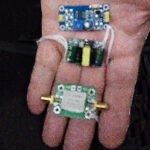
1 June 2023 – Chinese Modules – by Don, G4LOO

Just three modules described

Don titled this presentation Chinese Modules, as cheap as chips? And they truly were! These mass produced modules are produced in vast numbers by automatic assembly and are flow soldered for accuracy.  While not, perhaps, always as accurate as described in the included descriptions, they can do the job if not driven to the max etc.

First described were those units that were DC to DC converters,.      labelled as ‘Buck or Boost’ they are useful for DC Step up or Step down. They come in a range of voltages and cost just under £2.00 each, most with P & P included, from a number of dealers both in the UK and China.  Several modules were described for higher voltages and currents.

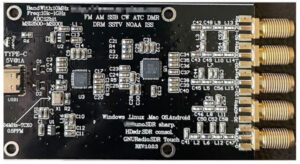
Next to be described were Switch mode power supplies, followed by Relay and timer modules, then Digital panel meters of various sizes and power handling. There were also modules for Audio such as 3V to 5V microphone preamps, and other higher powered amps for a bit over £2.00. Also described was an SDR module for just over £17.00.

Last but not least were the RF and Test modules. These included a 2W RF linear broadband amp for just over £10.00.  In total, Don described eight modules just used for measuring and testing, all well priced.

Don answered a few questions about how he had used the modules and during the presentation, passed around the modules for members to look at.

Simple 10kHz To 1GHz SDR

PS. In all, Don described 34 modules!


An active amateur radio society with a wide range of activities and benefits for members.