All posts by G4YRF

18 Jan 2024 – Ship’s Radio Officer’s Story by Derek M0YAW

Derek, M0YAW, gave a brief overview of his work experience and up to the present day. He spoke of his training in electronics such that he could service any make of radio equipment, receiver or transmitter. He worked for BP on tankers ranging in size from 80,000 tons to 400,000. He circumnavigated the world twice and visited many interesting ports. Shore leave gave him the opportunity to experience some of the rarer destinations in the Pacific, particularly Pago Pago in the eastern district of American Samoa. In the tiny harbour, the tanker had a very slow discharge rate using one pump running at quarter speed, instead of four pumps each running at 3 tons per second! So he had plenty of time ashore. Derek was on BP ship British Wye when it was called into service under MoD charter in the Falklands War in 1982. All the crew on board were volunteers. Derek added that when they sailed south to Ascension Island, they all thought the matter of the Falklands war would be over before they arrived. The sinking of British warships made them realise just how serious their task was to be. Two particular events were recalled, one was the ship being bombed by an Argentine Hercules. The MV British Wye was carrying 36000 tonnes of aviation fuel and the aircraft made a low pass and the  bombs were pushed out from the loading ramp. The outcome was a scuffed deck where one bomb bounced from the deck into the sea. There was an almighty underwater explosion. Later when the WYE was transferring fuel to another ship, Derek explained that the ship’s gyroscope malfunctioned making the parallel course with the other ship very challenging. Derek did a manual reset of the gyroscope in 30 minutes instead of 30 hours. The end of the conflict with Argentina was also the end of Derek’s life as a ships radio officer. He was awarded the Falklands Service Medal. After working in sales, he moved into technical authoring.     A job that he is still doing!

Report by Paul, G1GSN
11 Jan 2024 – Welcome Back!

Paul, G1GSN reported “The welcome back, as always, was a low key affair starting with tea and biscuits. The ‘Welcome Back’ became a discussion that evolved around the use of FT8 on the 17m band and included non radio items such as classic cars, DIY and newly licensed radio hams. About a dozen members were in attendance”.

The meeting closed about 9pm.

14 Dec 2023 – Mince Pie Night

There was good attendance at our last meeting of the year. Lots of friendly conversations as well as the mince pies!

Don’t forget, Meetings will restart on 11 Jan 2024.

Have a Happy and Safe Holiday!


07 Dec 2023 – Annual Club quiz by David, G8UOD

Four teams of three members each too part. The questions were quite challenging, some obscure, and some looking back a good number of years.

In the end the team that won by a small margin was called “We Three Kings” (keeping in the Christmas spirit) , consisting of Paul, G1GSN, Owen, G0PHY, Ken, G4YRF.

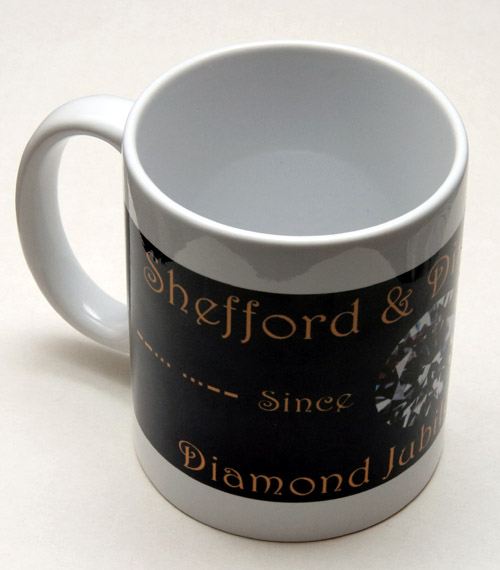
The prize this year for the winning team members was the new Diamond Jubilee Club Mug.  Soon to be available to all club members (at a good price).

Cup logo is as club website introduction page


30 Nov 2023 – GPS Basics, history and capabilities by Graham, G4JBD

Graham started by explaining the early entries into GPS with the Navstar constellation of 32 to 38 operational satellites orbiting 20,200 km above the earth in 6 inclined planes and travelling at a speed of 14000 km per hour. He explained the launch history from 1978 to the present.

The history wouldn’t be complete without mentioning people who provided the intellect and mathematics behind the success of the system. Ivan Getting, serving as Vice President of research and engineering at the Raytheon Corp. During the 1950s they produced the concept of using an advanced system of satellites to allow precise positioning data for locating moving vehicles etc, Getting also made significant contributions to the early development of radar as well as early space flight. Ivan Getting was Born Jan 1912 and Died Oct, 2003.

Another person recognised for the development of GPS was Roger Easton, for spacecraft tracking and navigation.  Also mentioned was Bradford Parkinson for his work with the Global Positioning system allowing users to determine their location with great accuracy. Of course, this system couldn’t have succeeded without very advanced mathematics provided by Dr, Gladys West. It has been said that GPS only exists because of two people: Albert Einstein and Dr. Gladys West

Graham showed a photo of the first GPS receiver in 1977 produced by Rockwell Collins. It had a large console with two seats for operators!  In 1981 Texas Instruments produced the Navstar receiver, not very portable since it was about the size of a bread bin. Current GPS receivers are now about the size of a finger nail! So small they turn up now in watches, bracelets and phones.

Graham continued by explaining the frequencies used by GPS in use by numerous countries and an explanation of just how a position on earth can be determined by four orbiting satellites.

Of course, just putting a satellite into orbit is only the starting point because the satellite will drift slightly due to drag and gravity producing timing errors. If the on board clock is out by plus or minus one second, the position accuracy can be out as much as 300,000 km.  Graham explained how these errors are corrected to give                   accuracy within 0.3m!

16 Nov. 2023 – Meteor Showers by Martyn Baker, G0GMB

Martyn stated that most  meteors are made of dust and Space debris, Small rocks make up asteroids. The majority of known asteroids orbit within the asteroid belt between Mars and Jupiter, generally with slightly elongated orbits. The belt is estimated to contain between 1 and 2 million asteroids larger than one kilometer (0.6 miles) in diameter, and millions of smaller ones. As the earth travels around the sun it runs into the meteor showers which have been attracted to the earth or the sun. As the shower enters the earth’s atmosphere they burn up producing ionizations that can reflect radio waves. Mostly 4m and 2m are used to ‘bounce off’ these meteor trails.

Early radio amateurs interested in this mode of propagation had to record Morse signals to be transmitted at high speeds  to take advantage of the ionization bursts which can last about half a second and at times a bit longer. Of course the transmissions needed to be recorded at the receiving end and played back at a slowed down rate. Modern software now allows all this work to be done in the PC. Software also predicts when these meteor showers can be expected throughout almost every month in the year, as well as providing internet contacts with other operators to set up schedules for contacts.

This part of the hobby does require a person who likes to stay up very late at night for only a few seconds of contacts made by their computer.

9 Nov. 2023 Autumn Junk Sale

A good gathering attended the Shefford and District Amateur Radio society’s annual junk sale.  To call it junk would be a misnomer, since numerous items were new and unused!  Our sincere thanks go to Graham Barber, G3WQT for his shack clearance items. There were many, and they were boxed and recorded to provide easy access. In addition, there were many useful items provided by John, M0DHD from his shack clearance.

Don, G4LOO and David, G0UOD stood in as auctioneers while Owen, G0PHY collected payments.

Many members and visitors left the hall with large boxes full of goodies

NOT JUNK -JUST SURPLUSS

26 Oct 2023 – RTTY over Internet by Sean, M1ECY

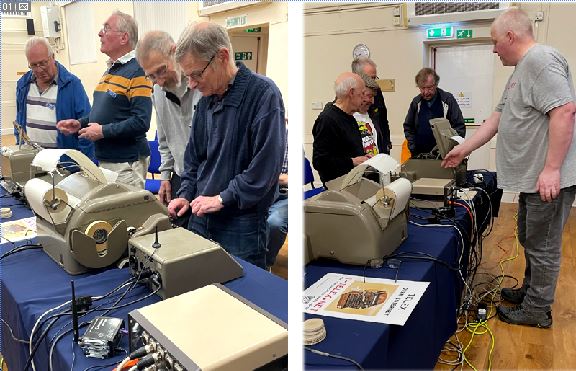
Sean began by explaining the evening would be a demonstration rather then a presentation. He had lined up several examples of the Teletype terminals with internet connections. The demo would show how terminals could contact each other over the internet.  A Q&A soon followed and one reply was contacts between owners with terminals could access a directory of those other persons interested in making contacts. So, in that aspect, it works like a telephone system. Unlike RTTY over radio where anyone tuned in could listen

This system seems a good idea for those interested in collecting these machines to put them to good use without licensed transmitters and aerials  In answer to a question about baud used, Sean said it was all 50 or 75 baud.

Sean explained his collection of machines come from U.S. England and around the EU. For the most part, although these machines can be rather old, the only maintenance was brushes for the motors as they would normally ware out over time and use.

Members had a chance to be “hands on” while asking questions and Sean explained some of the finer points of operations.


19 Oct 2023 – local elections

Sorry, but there will be no meeting at the hall tonight, the venue is being used for local elections.

Next week, our meeting will  host a visiting speaker presenting a RTTY over the Internet demonstration by Sean M1ECY