15 Jan. 2015 Video Evening

Marconi BD-272 RF unit

Don, G4LOO showed two videos, the first was about the Woofferton transmitting station, the last remaining UK shortwave broadcasting site, located at Woofferton, south of Ludlow, in Shropshire. The station was originally built by the BBC during World War II to house additional HF broadcasting transmitters. It had six 50 kW RCA transmitters. The site has been modernised many times over the years and during the Cold War, the station was equipped with six Marconi BD272 250 kW shortwave transmitters.

Woofferton Transmitting Station currently has ten HF transmitters. There are 3 x Riz 250 kW (installed 2007-2008), 1 x Riz 500 kW (installed 2006), 4 x 300 kW Marconi B6124’s (installed 1980) and 2 x 250 kW Marconi BD272’s (installed 1963).

The second film was a digital conversion of  8mm movies shot at field days during the 1960s.

11 Dec 2014 – Mince Pie Evening

Well, that was the last meeting of the year. Members gathered for a chat and mince pies, although some brought something more substantial.

Have a great holiday and come back for our first meeting on             the 8th of January, 2015

4 Dec 2014 – A Dip Into the Archives

The RSGB holds one hundred year’s of archive materials and Elaine Richards, G4LFM, explained how they are researching and cross referencing them. With assistance from Martin Atherton, G3ZAY, They have photos, documents, notes and QSL cards to sort for cataloguing. Scans and other digital files are being made using industry standards to facilitate access in the future.  It is planned that the files will be made available to members for their own research. With a view to the future, Elaine stressed the importance of members to record their own ‘Living memory’ to be added to the archive.

27 Nov 2014 – The Club Quiz

David, G8UOD presented the annual club quiz this year. Most questions were  general knowledge and a few answers generated humorous reactions.  The five teams were chosen by drawing lots and after an interesting evening, the  winning team of four were: Victor, G3JNB, Alan, G4PSO, Quentin, G0BVW and Bryan, M0BIK.

20 Nov. 2014 – Terry Giles, G4CDY recreates The Aerial Circus

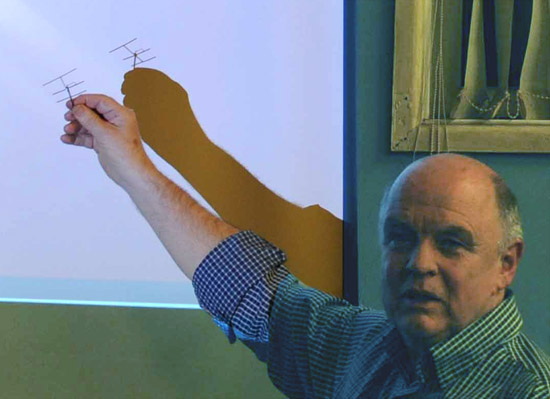
Terry started with the video of ‘Dud’ Charman, G6CJ made in 1981 by the Bristol TV Group. Dud’s aerials were scaled down versions of those used by amateurs today, and due to the small size of the models the frequency needed was in the microwave band (3200 Mhz). Dud wanted to display a three dimensional impression of the antenna’s radiation pattern that was more meaningful than the usual two dimensional patterns presented in books.

Terry had various aerials and showed their output on a meter projected on a large screen. The outstanding difference between Dud’s equipment and that used by Terry was the 1000v that Dud needed to power the klystron while Terry used a chip powered by the output from his laptop’s USB port!

Then and Now comparisons
Then and Now comparisons.                                                                                             Photo by Paul, G1GSN
The two inch scale
The two inch Yagi                                                                                                    Photo by Paul, G1GSN


13 Nov 2014 – A DVD about RADAR

This film described the early achievements in the development of British radar and covered the Chain Home system through to                microwave radar. It  detailed how essential the systems were during WWll.

WAAF radar operator Denise Miley plotting aircraft on a cathode ray tube in the Receiver Room at Bawdsey 'Chain Home' station, May1945.
WAAF radar operator Denise Miley plotting aircraft on a cathode ray tube in the Receiver Room at Bawdsey ‘Chain Home’ station, May1945.

6 Nov. 2014 – Paul Schimmel tells about Heathkit

Early Heathkit
Early Heathkit

Paul started by explaining the 23 items of equipment he had brought to display, all of which were shown to be working.

Although the company didn’t actually start with kits for audio and test equipment in 1929, by 1947 their first oscilloscope kit was introduced. This proved very popular and was followed by a valve volt meter. The kits were very well presented and included ready made metal cases.  The documentation insured building and testing resulted in near 100% success, and the company provided help when needed.

Through the years the company was taken over by numerous other companies but always remained a favourite amongst the radio amateur fraternity. However, in the seventies, equipment was coming into the country from Japan which was ready built and tested for the price of the kits.

Today, Heathkit projects, although no longer manufactured, are still popular since they are easy to service or restore if you have access to the original documentation.

Bryan, M0BIK and Brian, G8GHR showed their collections of Heathkit amateur radio equipment. Bryan explained some of the components used and detailed the U.S. made valves which were the choice of the American Heathkit company in kits for distribution over there.

HK4HK3HK2

On the right side is the  Heathkit Mohican receiver and oscilloscope at G3JNB in 1971, Rig at the left side is a KW Atlanta.
On the right side is the Heathkit Mohican receiver and oscilloscope at G3JNB in 1971,
Rig at the left side is a KW Atlanta.

30 Oct 2014 – A News Reader’s Viewpoint by Paul, G1GSN

Paul detailed the readers in our area, both main, standby and backup.  The scrip is supplied by the RSGB and according to the terms of the reader’s NOV, can’t be altered. The weekly script is made up of the header and trailer which doesn’t change much from week to week but the actual news which is sandwiched in the middle, does.

The main news is then followed by the ‘Local’ news. However there seems to be a problem at the RSGB in pinpointing just what is local to Paul’s QTH. For instance, Paul’s local news does not contain items pertaining to Shefford, Bedford, Cambridge, Huntingdon nor Milton Keynes; all areas within the boundaries of his transmissions. However, those listed as ‘local’ are all some distance away and for the most part are covered by other newsreaders actually in those areas.  While newsreaders need a good readable signal, running more power than needed for local reception can cause conflicts  in other newsreader’s territories.

Discussions followed which included our club programme details which should appear in Radcom, and the local news broadcast, but after numerous emails and phone calls still don’t appear on a regular basis.

Paul stressed the importance of feedback after each broadcast, which could be compiled and presented to those who co-ordinate the broadcasts in an effort to improve the service.

An active amateur radio society with a wide range of activities and benefits for members.