28 April 2016 – PSK demo

Richard operating the rig
Richard operating the rig.                                                                                              Photo by Paul, G1GSN

An attempt was made to explain how to set up a PSK programme including writing macros to suit the operator’s preferences since some, by default in the installation, are not the wording that might be chosen by the members present.

Richard, G3NII supplied the rig, interface and laptop, while Ken, G4YRF supplied the necessary software and descriptions. Don set up a 40M dipole outside (in the rain) for the operation.

Digipan was chosen as the starting point as it seems to be the easiest to set up and get running.  Later, FLdigi was installed and the set up was found to be somewhat problematical. However, we did identify some PSK31 and PSK64 transmissions which enabled members to see the macros being used in PSK  QSOs. It was pointed out that the changes in the macros were done in very much the same way as Digipan, with a few exceptions.

Some features in FLdigi were pointed out which indicates how useful this particular programme is, especially with the many modes to choose from.

21 April 2016 – Spring Junk Sale

There was an excellent turnout for this year’s junk sale with as many visitors as members. The total attending was 35.  The quality of the ‘junk’ was quite good and most was sold for good prices. Working hard as the auctioneers were Don, G4LOO and David, G8UOD who managed to keep the treasurer busy collecting the money. Afterwards the tea and biscuits were ‘on the house’

14 April 2016 – Telecommunications by Ian Rainbow-Wood

The Museum at Milton Keynes is almost an unknown treasure. Their latest addition tells the story of communications from signal fires to electronics. Visitors can learn to send and receive Morse code, practice sending signals up the railway line 19th century style, visit a police phone box, and play at being a switchboard operator at a fully working telephone exchange.

Ian displayed some early telephone equipment including the Strowger switch which led to the first commercially successful electromechanical stepping switch telephone exchange system eliminating the need for a telephone operator to connect callers. It was invented by Almon Brown Strowger, and first patented in the United States in 1891. Because of its operational characteristics it is also known as a step-by-step (SXS) switch. Other items of early telephone equipment were displayed for members to examine.

A Strowger Switch
A Strowger Switch

2016 Club Lunch

8367
L to R Victor Brand, Mrs A. Brand, Owen Williams, Brian Farey
8342
L to R Mrs. Amos, Ken Amos, John Airey, Mrs Airey
8346
L to R Brian Farey, Steve Durham, Mrs. N. Durham
8351
L to R Ian Taylor, John Burnett
8359
L to R Mrs Williams, Victor Brand, Mrs. Brand
8334
L to R Steve Durham, Mrs. Durham, Mrs. Amos, Ken Amos
4 presentations
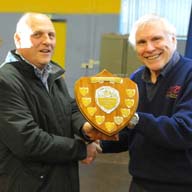
Top left Victor wins G2DPQ cup, Top Right Steve Wins G4CBI cup. Bottom Left, Brian wins the G3JKK shield, Bottom Right, Owen receives the Club Quiz trophy on behalf of the team.
Don wins First Place in Major Project competition


7 April 2016 – A General Discussion

Our ‘Natter Nite’ was brightened by Paul operating his new IC7300 rig with the use of Martin’s home brew remotely tuned loop  antenna which was placed just outside.  Victor took to the key and worked a station in Eastern Europe with very strong signals both ways on 20M. Other stations were monitored on various bands. General discussions followed.


31 March 2016 – ‘Bats in Beds’ by Dr. Gill Clough

To date, there are eighteen species of bat known to live in the UK, of which most can be found here in Bedfordshire. Dr. Clough detailed some of their calls and played recordings to illustrate the differences. Their method of echo location was also described.

As a member of the Bedfordshire Bat Group she has participated in park surveys to record bat activity at several locations where they spend an evening counting bats in and out of their roost. The group also participates in bat detector surveys, sonogram analysis, mist nets and at times, radio tagging.

Several hand held bat detectors and recorders were displayed with an explanation as to how they differed in their method of detection.


17 March 2016 – Local Industry

Brian, G8GHR started by outlining radio and electronic firms that were in Bedford and nearby towns. Possibly the largest was Bedford Igranic who produced switch gear, radio components, wireless kits and finished sets. Among their work force were two prominent
radio amateurs, Dud Charman, G6CT and Ham Clark, G6OT. Other Bedford companies outlined were Texas Instrument, the much smaller Radio Exchange, who sold war surplus equipment and The Bedford Electrical & Radio Co. Ltd. which closed in 1940. They were
known for their ‘Peerless’ brand.

Perhaps one of the oldest companies in Bedford was Cryselco making light bulbs in 1895.  During the First World War they made the famous r valve for wireless sets.

Ian, G3ORG told of his time at Cincinnati, one of Biggleswade’s largest employers for almost forty years, producing high precision machine tools for industry. The company had developed from the Cincinnati Milling Machine Co. which had started in the USA in 1884. By 1960 they were the largest machine tool builder in the world. However, the downward slide in business resulted in redundancies as other companies abroad came into the market and In 1987 the firm was sold and the site was cleared for redevelopment.

Bryan, M0BIK told  of Cyfas, Biggleswade which started in Crawley in 1968 making display boards for control rooms. Vehicles so equipped could send data bursts to show their location on a control room map. This reduced the need for voice communications.
The company went on to produce communications control systems and alarm monitoring equipment with touch screen technology. The company survived many takeovers and buy outs through the years and is now the only company of those described during the evening which is still operating.


10 March 2016 – Principles of Fire Investigation

An excellent turn out came to hear Martin, M6SCI speak about fire
investigating. Matters such as their right to investigate and legal
obligations were discussed.

Martin explained how the seat of a fire could be identified and described the results from a smouldering or flame fire. Smoke and silhouette patterns were analysed.

Some actual case studies were examined and the indentifying features were examined . Martin pointed out that most situations were not as usually seen on forensic TV shows!

4 March 2016 – The AGM

A good turnout of members attended the club’s 67th Annual General Meeting.
The Officers and Committee members were returned unopposed. They are:

Chairman Ken, G4YRF
Vice Chairman Bryan, M0BIK
Secretary John, 2E0OAK
Treasurer Owen, G0PHY
Equipment Officer Don, G4LOO
Committee member Paul, G1GSN
Paul, M0PSW
Gareth, M5KVK
John, G6RHL
David, G8UOD
Martin, M6SCI

After it was pointed out that the subscription rate hadn’t changed since 2008 the assembly unanimously voted to increase the rate to £30 per year. The meeting was wrapped up early (for an AGM!) and tea and biscuits were served.

25 Feb. 2016 – Royal Signals – Part Two

Wireless Set No. 1 a Portable transmitter/receiver developed in 1933
Wireless Set No. 1,  a Portable transmitter/receiver developed in 1933

David, G8UOD began by saying his talk would cover the period between WWl and WWll, but it was pointed out that, although the country was not involved in a World War before 1939 there were numerous smaller conflicts involving Great Britain. During this time progress was being made in communications, and by 1933 the first of the ‘numbered’ sets was in use. Of course, it was called Wireless Set Number One.

At the start of WWll numerous sets from the first war were still being used, most likely due to the effects of the depression. However with the onset of WWll the Royal Signals quickly organised their ever growing numbers into various groups of command. In 1939 they totalled 43,332 persons which grew to 150,990 by 1945. All aspects of communications were eventually covered from laying land lines to mobile communications, cryptographic, and even deception transmissions as cover  for the D Day landings.

Wireless Sender No. 76 developed in 1943
Wireless Sender No. 76, a portable transmitter  developed in 1943

Photos from Wireless for the Warrior                                   http://www.wftw.nl/wsets.html


An active amateur radio society with a wide range of activities and benefits for members.